
What Real Data from Global Brands Reveals About Employment, Profits, and Impact
The global economy, a vast and intricate system, is powered by two distinct yet increasingly intertwined forces: product-based companies and service-based enterprises. From tech giants like Apple and Tesla to professional services firms like Deloitte and innovative platforms like Airbnb, each model plays a critical role. But how do they truly compare in terms of employment generation, profitability, societal impact, and influence on our daily lives? We delved into real-world data to reveal the dynamics of this balance of power, offering a clear perspective on which engine drives what and how their synergy is shaping our economic future.
1. Employment: Who Hires More?
When it comes to jobs, service businesses are the undisputed heavyweights.
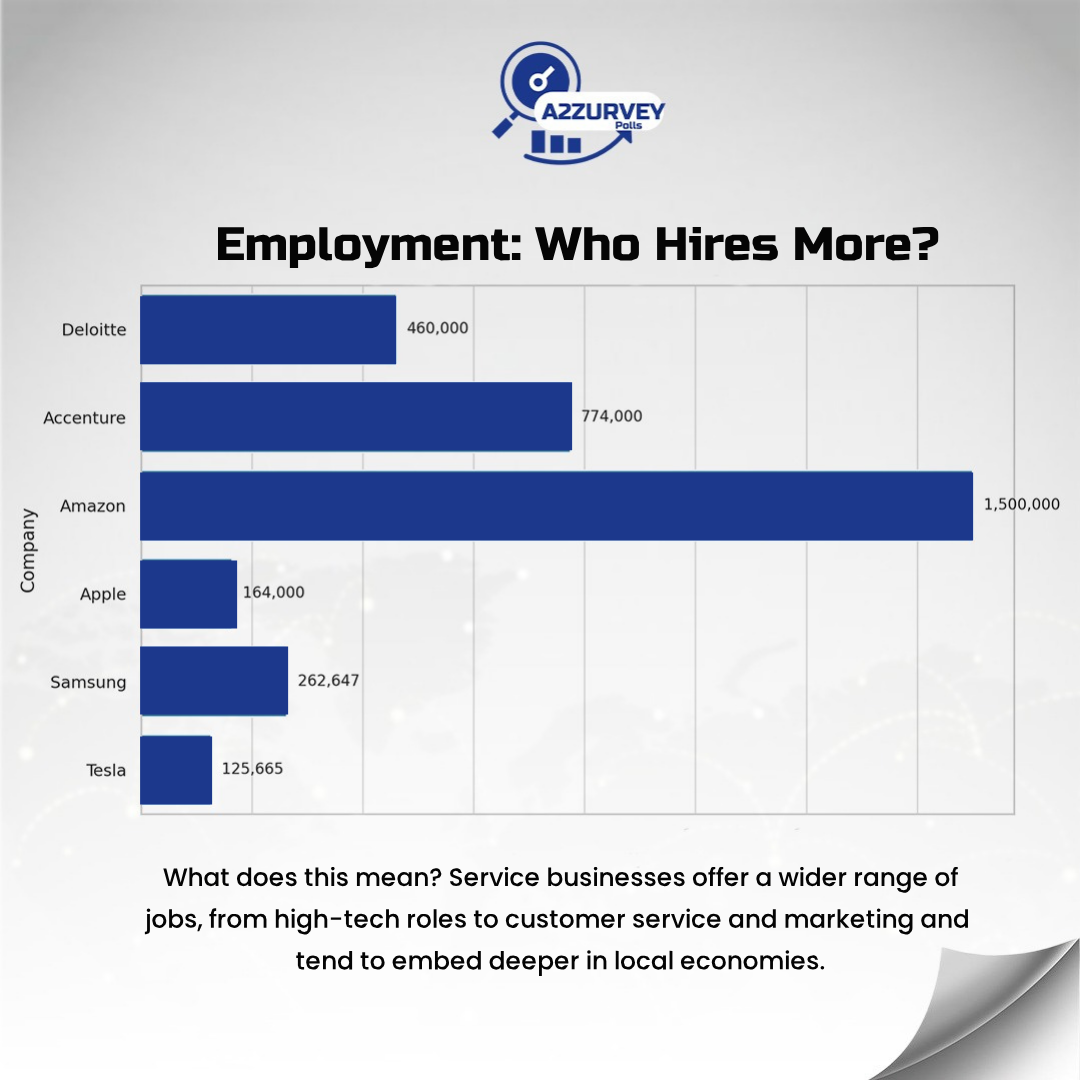
Deloitte, the world’s largest professional services firm, employs over 460,000 people globally, spanning audit, consulting, legal, and advisory services. Accenture tops even that, with 774,000 employees across 120+ countries. Amazon, while known for selling products, is ultimately a hybrid business driven by logistics and services, and it employs over 1.5 million people worldwide, from delivery personnel to cloud engineers.
In contrast, product businesses run leaner. Apple, despite its massive reach and profits, maintains a team of around 164,000 employees. Samsung, a tech and manufacturing powerhouse, employs 262,647 people globally. Tesla, the poster child of 21st-century industrialism, employs 125,665 staff as of 2024; many of them are in engineering and automated production.
What does this mean? Service businesses offer a wider range of jobs, from high-tech roles to customer service and marketing and tend to embed deeper in local economies. They’re also more accessible to developing countries looking to boost youth employment and digital participation.
Insight: The service sector is labour-rich, adaptable, and increasingly critical for economic inclusion, especially where formal industrial jobs are scarce.
2. Profitability: Who Wins on Revenue?
While services lead on employment, product companies lead on raw financial power.
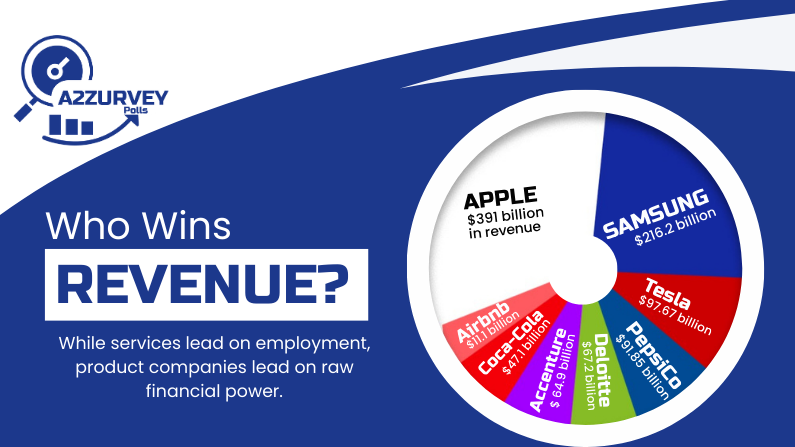
Apple remains one of the most profitable companies in the world. In 2024, it reported $391 billion in revenue and $94.9 billion in profit, more than the GDP of most countries. Samsung followed with about $216.2 billion in revenue, powered by global demand for electronics and chips. Tesla, meanwhile, earned about $97.67 billion in the year 2024.
Even FMCG brands like PepsiCo and Coca-Cola remain extremely profitable: PepsiCo reported $91.85 billion as revenue, while Coca-Cola hit $47.1 billion, despite rising health-consciousness globally.
On the service side, the numbers are strong but more modest. Deloitte crossed $67.2 billion in 2024. Accenture brought in $64.9 billion. Airbnb, despite having fewer than 8,000 employees, earned above $11.1 billion, showing how platform-based models can punch above their weight.
Insight: Product businesses dominate global revenue due to economies of scale, physical assets, and brand equity. Once you build a product and a supply chain, the margins on distribution, whether it’s a smartphone or soda, are remarkably high.
3. Social and Economic Impact: Who Builds and Who Includes?
Product brands often drive large-scale infrastructure and industrial capacity. Tesla, beyond cars, is reshaping how energy is stored and distributed, including projects in the US and other parts of the globe. Samsung is investing in chip manufacturing, display panels, and smart homes, which contributes to laying the digital foundation of modern living. In Africa, Dangote Industries is building self-reliance by producing cement, fertilizer, and refined oil, reducing dependency on imports and driving infrastructure growth.
Meanwhile, service firms often drive inclusion, adaptability, and community upliftment. Deloitte partners with governments to improve public finance, education, and ESG frameworks. Airbnb has enabled millions of everyday people, from Lisbon to Dakar, to generate income from their homes. AWS provides cloud infrastructure that powers thousands of startups and SMEs in developing countries.
Insight: Product companies build long-term systems, while service businesses tend to focus on adaptability, access, and inclusion. Both play essential roles: one creating structure, the other creating opportunity.
4. Health, Wellness, and Lifestyle: Who Keeps Us Moving?
Modern business is about more than products and profits. It’s also about shaping how people live, move, and feel. Product companies like Nike, Adidas, and Lululemon lead the charge in identity-based consumption. Nike posted billions in 2024 alone, driven not just by athletic gear but by its storytelling around movement, community, and equity. Coca-Cola and PepsiCo, while once synonymous with sugar, are now investing heavily in wellness—pushing zero-calorie, hydration, and vitamin-infused drinks to respond to shifting consumer habits.
On the other hand, service brands are at the heart of digital wellness. Platforms like Calm, Peloton, and Headspace are making mindfulness and fitness more accessible than ever, particularly post-pandemic. Social platforms like YouTube and Instagram now feature global wellness creators guiding users through yoga routines, mental health tips, and nutrition hacks.
Insight: Product firms create the tools for physical expression and lifestyle branding. Service platforms shape emotional health and behavior. Together, they’re building a world where wellness is constant and curated